Where I stayed
Links marked * are affiliate links. I may earn a commission on qualifying bookings. Only use what’s useful for your trip.
Ostello Bello Roma Colosseo · Rome
My rating: 9.5 / 10
My take: Incredible location, right next to the Colosseum. Very sociable with super helpful staff. The rooftop terraces were a great addition (especially if you want to do a spot of yoga, work out, or relax in a hammock with your book!)
Check prices & availability on Hostelworld* ↗
Hotel Neranxi · Himarë
My rating: 8.5 / 10
My take: Beautiful room with a lovely balcony at a great price. Not the most sociable and a little light on amenities but you’re minutes from the beach and a fantastic breakfast at Astro’s.
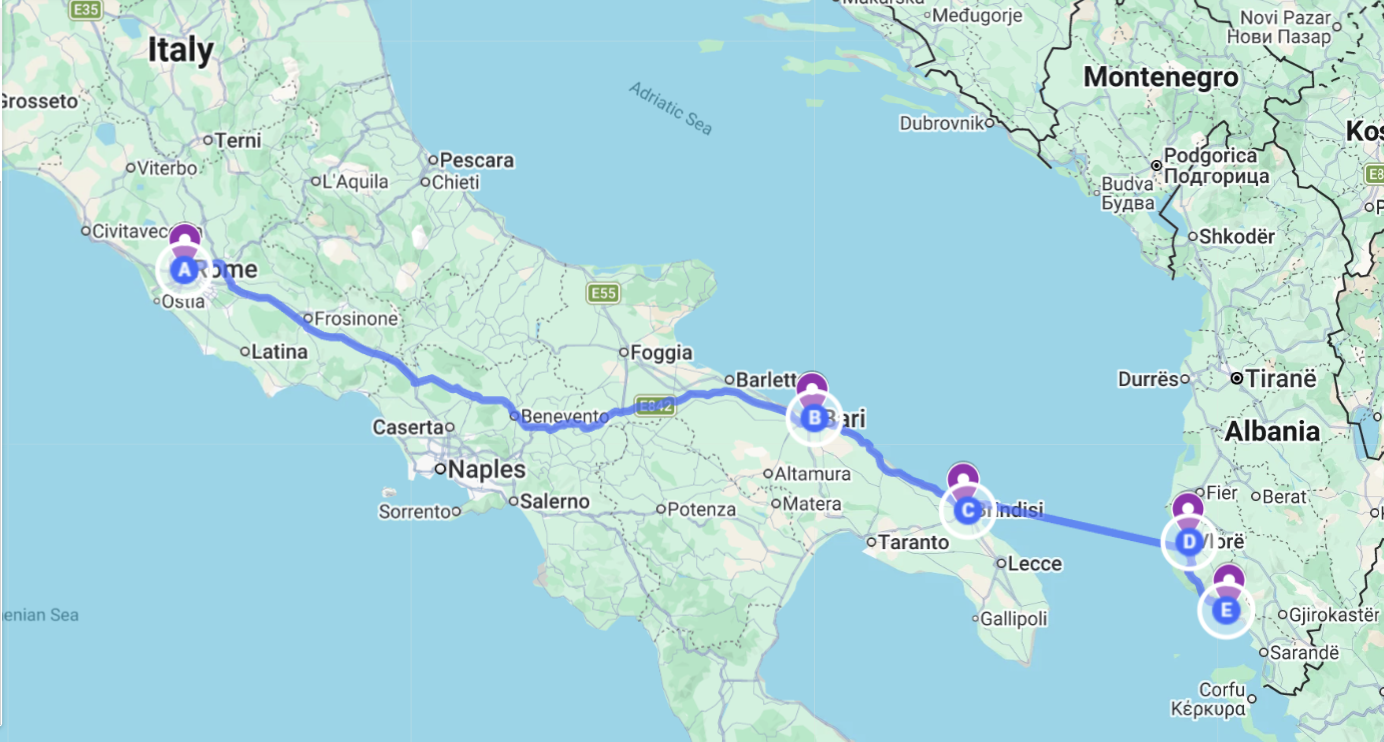
Yes, you can travel from Rome to the Albanian Riviera without flying: I used two trains to Brindisi, an overnight ferry to Vlorë and a bus to Himarë. I would do it again, with more food packed and fewer expensive things attached to the outside of my bag.
- My journey was 1–2 September 2026; the times and fares below describe that trip.
- Book the train and ferry with enough margin for the port transfer and check-in deadline.
- Confirm that your Brindisi AP bus serves Costa Morena and check the current stop notices.
- Collect the ferry boarding pass; an emailed booking is not necessarily sufficient.
- Carry Albanian cash in smaller notes and confirm the onward bus locally.
- Check the final walk to your accommodation before arriving tired and warm.
Rome to Himarë without flying at a glance
Route: Rome → Bari → Brindisi → Vlorë → Himarë
Travelled: 1–2 September 2026
Getting from Italy to Albania without flying looked unnecessarily complicated when I started researching it. There was plenty of information about individual trains and ferries, but surprisingly little explaining the whole journey from central Rome to the Albanian Riviera.
So I did it: two trains, an overnight ferry, an Albanian bus and rather more sweaty walking than I’d intended.
Would I do it again? Absolutely. Here’s what worked, what I paid and what I’d change.
The route and costs at a glance

| Part of the journey | My journey | What I paid |
|---|---|---|
| Rome → Bari | 13:15–17:43, Frecciarossa | €69 |
| Bari → Brindisi | 18:02–19:14, Regionale Veloce | €10.60 |
| Brindisi → Vlorë | 23:30–07:00, overnight ferry with an allocated reclining seat | £62.23, approximately €73, including booking fee |
| Vlorë → Himarë | Bus the following morning | 800 lek, approximately €9 |
My exact transport charges were €79.60 for the trains, £62.23 for the ferry including its booking fee, and 800 lek for the onward bus. Those charges exclude the port bus, meals and a 600-lek ATM withdrawal fee. The approximate €161 transport total in my original notes depends on the exchange rates used; the original-currency figures are the reliable comparison.
These are my September 2026 journey details, rather than a guaranteed timetable or current quote. Currency conversions are approximate; check your dates before booking.
My main advice: buy your ferry snacks before leaving Rome, follow your ferry’s check-in instructions, carry Albanian cash in smaller notes and keep expensive electronics inside your backpack.
Rome to Brindisi by train
I booked directly through Trenitalia, travelling from Roma Termini to Brindisi with one change at Bari Centrale.
My first train was Frecciarossa 8311, departing Rome at 13:15 and arriving in Bari at 17:43. Standard class cost €69.
I then took Regionale Veloce 4427 at 18:02, arriving in Brindisi at 19:14. That ticket cost €10.60.
Total: 5 hours 59 minutes and €79.60.
This was comfortably the easiest part of the journey. My 19-minute connection in Bari worked smoothly, but it left little room for a delayed first train. I wouldn’t treat that as a universally comfortable connection—especially with a ferry to catch afterwards.
Would I visit the Colosseum that morning again?
No.
Because crossing Italy and boarding an international ferry apparently wasn’t enough activity for one day, I booked a 09:15 Colosseum visit before leaving Rome.
Technically, it worked. My train wasn’t until 13:15, so I had time to visit, collect my luggage and get to Termini.
But it added several kilometres of walking through summer Rome before a journey that already involved carrying everything I owned across two countries.
If it’s your only opportunity, it may be manageable with careful timing. Otherwise, see the Colosseum another day.
Start your travel day with coffee.

Buy your ferry food before leaving Rome
This is something I’d definitely change.
I assumed I’d comfortably pick up supplies in Brindisi. I did eventually find a Conad, but supermarket-hunting somewhere unfamiliar, with all my luggage, while working out how to reach the ferry port was an unnecessary side quest.
The shop also offered surprisingly little that translated into “things I actually want to eat overnight on a boat”.
There were food and drink options aboard my ferry, so bringing supplies wasn’t essential. But if you want your own snacks, breakfast or water, sort them out before leaving Rome.
Then, when you reach Brindisi, you’ve got one job: get to the port.
Brindisi railway station to Costa Morena ferry port
STP’s Linea AP connects the airport, central Brindisi and Costa Morena, where the ferries depart.
Use the current Linea AP timetable and STP service notices to confirm your stop and a journey that actually serves Costa Morena. Some later AP journeys omit the port, so the route name alone is not enough. STP also lists a Piazza Crispi stop suspension from 12 August 2026; check the current boarding point rather than following an old station map.
I allowed roughly €2 for this transfer in my notes; my exact paid fare is not confirmed. The published timetable says tickets bought aboard carry a surcharge. Check the applicable fare and purchase method before travelling rather than treating my planning allowance as the official price.
My practical observation: make yourself visible to the driver. I wouldn’t rely on the bus majestically pulling up and announcing itself to confused international travellers.
See the right bus? Give ’er a wave.

Ferry check-in at Costa Morena
My ferry departed at 23:30. Arriving in Brindisi at 19:14 gave me time to reach the port and work through the boarding process.
For this route, plan to reach the StarLines check-in office at least three hours before departure: 20:30 for a 23:30 sailing. Its current TNIT conditions also state that check-in closes 90 minutes before departure. Confirm the instructions attached to your own booking, including where to collect the boarding pass. StarLines boarding conditions.
Arriving early left me waiting at the port, but finding the bus and navigating check-in took some luck and local assistance. I would keep the buffer. An industrial car park is an unglamorous place to spend an evening; missing your ferry is a worse use of it.
My evening involved a slightly ridiculous sequence:
- Take the bus to Costa Morena.
- Take a shuttle backwards to the ticket office.
- Collect the physical boarding ticket.
- Take the shuttle back towards the terminal.
- Wait…
We started moving through passport control at around 21:30. It was fairly painless and I think all in all it took 30–45 minutes to get on the boat, and about 4.5 minutes to buy a beer.
StarLines’ FAQ says an emailed booking is not the boarding pass: collect that from its ticket office at the departure port. Official boarding-pass guidance. My shuttle sequence describes that evening, rather than a guaranteed terminal procedure.
What Costa Morena feels like after dark
The ferry terminal can feel a bit like no man’s land at night.
You’re standing around an industrial port. It’s dark. You don’t necessarily speak Italian. You’re not entirely sure what happens next. You’re unlikely to be surrounded by English speakers (I think the majority of other travelers were Albanian or Italian – this will likely not shock you…)
I won’t lie, I found it a bit intimidating at first (I may or may not have posted a comedic “sending up my first emergency flare” while standing in the somewhat derelict carpark, listening to a boisterous Albanian family yelling at each other in the background).
What helped was asking myself whether the same place would bother me in daylight. Probably not. I was surrounded by families, drivers and other passengers; darkness, travel fatigue, and stray cats were doing most of the psychological work.
Nothing sketchy happened on my visit. Once things started moving, passport control was straightforward: show my passport and continue towards the ferry.

Brindisi to Vlorë by overnight ferry
I booked through Ferryhopper.
My sailing was aboard Ionian Star, with StarLines:
- Departure: Brindisi, 23:30.
- Arrival: Vlorë, approximately 07:00.
- Scheduled crossing: 7 hours 30 minutes.
I paid £58.72 for the ticket, plus a £3.51 booking fee: £62.23 altogether, approximately €73 at the time.
My booking described the accommodation as a Business seat. This description feels like a very liberal use of the term “Business”, or at the very least, we should be asking “what business?”.
Here is what the seat was actually like.
Is the reclining seat worth it?
This is not Emirates.
There is no champagne. Nobody knows your name. There are no fancy slippers.
What I got was access to a room with some semi-functional reclining seats, some less so, in a dedicated indoor lounge—and I would pay for it again.
It meant I had somewhere more specific to sit and attempt to sleep, without having to find a spot in the general passenger areas.
Did I enjoy a glorious, uninterrupted night?
Absolutely not.
A family with young children and a group of teenagers kept the lounge lively until roughly 3am. “Business” did not extend to a peaceful night’s sleep.
But I still had an indoor reclining seat to myself. For my budget and travelling alone, that felt like a worthwhile compromise. And, the sunrise over Albania as we arrived at the port, made it all entirely worth it!
If sleep matters more to you, compare cabin options for your actual sailing.
And whichever option you choose, bring earplugs!
Arriving in Vlorë: cash first, byrek second
We arrived at around 07:00.
My first priority was Albanian cash. I withdrew 10,000 lek and the ATM charged an additional 600 lek. Those are the transaction amounts from my journey, not a promise of today’s fees or exchange rate. Your card provider may charge separately; check your own account’s withdrawal allowance.
Read the ATM fee before accepting the withdrawal. Charges varied during my trip, so do not assume every machine offers the same terms. I later remembered finding a 500-lek fee, but the bank identity is still unconfirmed; I would not send you looking specifically for ABI on that evidence.
On this journey, cash was essential—particularly for the onward bus and smaller purchases. Plan your cash needs to reduce repeated fixed ATM fees without carrying more cash than you are comfortable with (Albania may not be quite as cheap as you imagined and you will be likely be paying your accommodation costs in cash too). Carry smaller notes if you can (break your 5,000 notes in a bigger store or on more expensive dinners). A 5,000-lek note is pretty evil when you’re trying to buy something costing 200 lek (see below).
Breakfast: get the byrek

Recommended spot: Byrek Çasti Vlore
Before heading south, I stopped for byrek and coffee.
Excellent decision.
Cheap, filling and exactly what I wanted after getting off an overnight ferry.
You’re about to get on an Albanian bus. Don’t overthink breakfast.
Get the byrek.
But try not to pay your beautiful, patient, and very exasperated chef with a 5,000 lek note at 8am – you will wipe out her change, and you will feel really bad about it.
I ended up buying 3 byrek, 1 yogurt, a double espresso, and 2 bottles of water to try to make the payment a bit less painful. I ate like a king… for a while… and she disliked me a little less (I hope..)
Vlorë to Himarë by bus
This was the part I’d struggled most to research confidently.
The bus journey worked. Finding it involved rather more local assistance than an Italian train platform.
I asked locally and waited at a roadside point shown approximately in the map below. A local spotted the bus, waved and ushered me aboard. It stopped on the main road, and briefly I became the traffic.
This pin records roughly where I boarded in September 2026. It is not a verified permanent bus stop. Ask locally for the current departure point and service before committing to the roadside option; a marked station may be the more predictable choice.

Confirm the departure location and next bus locally when you arrive, ideally before wandering off with your luggage.
The bus had Himarë displayed in the window, which was considerably more useful than much of what I’d found online.
I paid 800 lek in cash. That is my fare on this journey, not a verified 700–900 lek range or current quote. Confirm the fare and drop-off with the driver before boarding.
My rucksack went (vigorously…) into the luggage compartment and off we went.
The coastal drive
My journey south delivered mountains, the Ionian Sea, villages and some fairly enthusiastic switchbacks.
After the overnight ferry, watching Albania unfold through the window was a lovely way to arrive.

Somewhere around this bus journey, I also lost my clip-on RØDE microphone.
So this particular piece of advice cost considerably more than the fare: put small, expensive things inside your backpack rather than loosely attaching them to the outside.
Don’t be a plum…
Arriving in Himarë: check the final walk
The bus dropped me near Himarë, but I still had roughly a 30-minute walk to my accommodation, Hotel Neranxi, by Potami Beach.

In the midday heat, sandwiched like a sweaty sausage between two backpacks, this was not my finest planning.
Ask where your bus will stop and compare that location with your accommodation. My drop-off left a substantial final walk; I cannot promise that every service stops at the same point. “Himarë” on the windscreen is a destination, not a delivery service to your front door.
If you want to avoid a long walk with luggage, ask your accommodation about an arrival transfer in advance. Otherwise, save the route and keep water accessible. The bus ride ending does not necessarily mean your journey has.
Would I travel from Italy to Albania this way again?
Absolutely.
If your priority is the quickest possible arrival, compare flights. This route involves an overnight crossing, several transfers and some uncertainty around the final bus.
For me, that was part of its appeal.
I left Rome, crossed southern Italy by train, boarded a ferry across the Adriatic, woke up in Albania, ate byrek for breakfast and continued down the coast.
It felt like I’d travelled between the two countries. I’d watched the journey happen.
The changes I’d make are fairly simple:
- Skip the Colosseum that morning.
- Buy food and water before leaving Rome.
- Check the port bus timetable and stop notices.
- Follow the ferry’s check-in deadline.
- Pay for a “reclining” seat again—or consider a cabin if I needed proper sleep.
- Carry Albanian cash in smaller notes.
- Check the bus drop-off against my accommodation.
- Secure my bloody microphone.
Otherwise, I’d do essentially the same thing again.
For the services I use while travelling, visit my Travel Toolkit.
Leave a Reply